

2025 Vol.5
Sustainable Urban Renewal
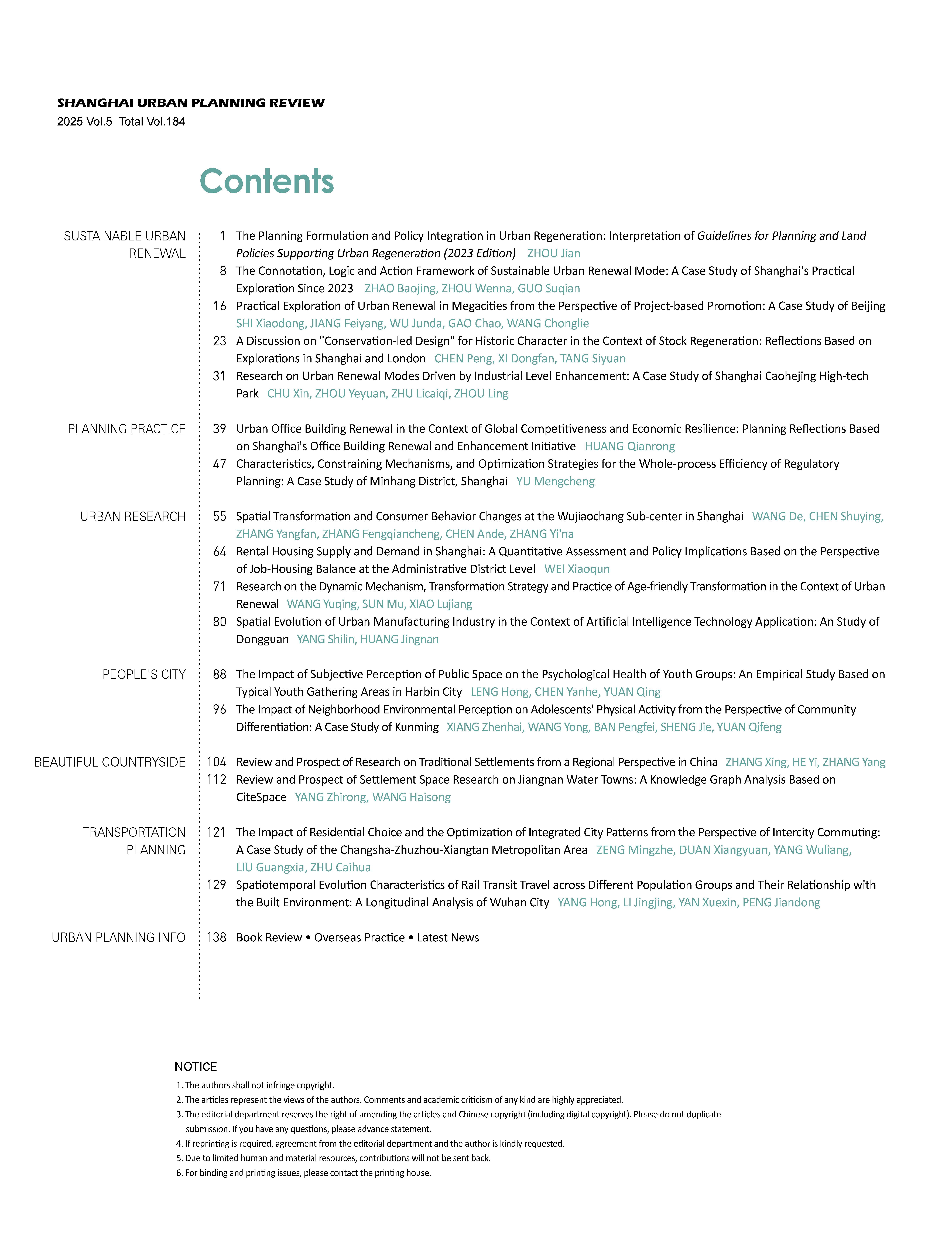
The Planning Formulation and Policy Integration in Urban Regeneration: Interpretation of Guidelines for Planning and Land Policies Supporting Urban Regeneration (2023 Edition)
Abstract: Since the 20th National Congress of the CPC, the central government has issued multiple policy documents on urban renewal and proposed to "establish a sustainable urban regeneration model and policies and regulations," which has guiding significance for the transformation of urban development methods in the new era. National territory spatial planning, urban renewal sector planning, and planning and land policies serve as the foundation and support for constructing urban regeneration models and mechanisms and promoting high-quality urban development. This article interprets the main contents of the Guidelines for Planning and Land Policies Supporting Urban Regeneration (2023 Edition) distributed by the Ministry of Natural Resources in 2023. Based on the understanding and insights gained during the process of compiling this policy document, this paper delves into the relationship between national territory spatial planning and urban regeneration, and how national territory spatial planning formulation and planning and land policies can be adapted to the characteristics of urban regeneration. The objective is to comprehend the background, core ideas, specific requirements, and direction of planning work, and to apply it to the planning and policy innovation related to urban regeneration.
The Connotation, Logic and Action Framework of Sustainable Urban Renewal Mode: A Case Study of Shanghai's Practical Exploration Since 2023
Abstract: This paper systematically examines the full-cycle characteristics of sustainable urban regeneration, Shanghai's practical framework, and optimization pathways. It proposes that sustainable urban regeneration models can be expanded into a three-dimensional framework system encompassing concepts, institutions, and planning based on their inherent logic. The conceptual dimension should shift value perspectives to balance urban economic development with the safeguarding of people's livelihoods. The institutional dimension should reconstruct a sustainable policy environment for regeneration and establish a multi-stakeholder work organization. The planning dimension should prioritize the transformation of the regeneration planning system and the innovation of multi-disciplinary collaborative technical methods. Drawing on Shanghai's practical experience, the paper summarizes specific measures in organizational mechanism building, planning methodology transformation, policy and regulation innovation, and specialized initiatives. It further suggests that Shanghai's future urban regeneration efforts need to better balance diverse interests, enhance social inclusivity, strengthen resource coordination, and advance digital governance, thereby serving as a model for sustainable regeneration in megacities and large cities.
Practical Exploration of Urban Renewal in Megacities from the Perspective of Project-based Promotion: A Case Study of Beijing
Abstract: The top-level design of urban renewal attaches great importance to the supporting and driving role of project implementation in the renewal action. Project-based urban renewal based on progressive decision-making theory, which breaks down the renewal strategy into specific projects and makes the renewal actions perceptible, traceable, and assessable, has become an important path for megacities to implement urban renewal. From the perspective of project-based promotion, by comparing the renewal practices of Beijing and Shanghai, this paper summarizes the project-based promotion and renewal model, introduces the characteristic experience of Beijing, and finally puts forward optimization suggestions. Research shows that the project-based promotion and renewal model, which includes project monitoring and management, problem feedback and coordination, practice promotion and publicity, and project incubation and advancement, can be promoted and replicated. Beijing has explored a full-process tracking technology route centered on demonstration projects, spatio-temporal coupling assessment methods, companion-style problem feedback coordination, and a mechanism for extracting and promoting scenario-based models, achieving remarkable results. The model needs to be dynamically optimized in combination with practice, strengthening innovation in planning guidance, collaboration among the government, enterprises, and the public, and key policies and systems.
A Discussion on "Conservation-led Design" for Historic Character in the Context of Stock Regeneration: Reflections Based on Explorations in Shanghai and London
Abstract: Against the backdrop of China's development fully entering a phase of enhancing quality and efficiency, how to leverage historical character in urban renewal has become a challenge for many cities. This study examines Shanghai's experience, which consistently centers historical character to construct holistic preservation and explore synergies between old and new. It also summarizes London's experience in unlocking the potential of historical environments through design to achieve sustainable growth. By comparing these approaches and analyzing the current challenges in Shanghai's historic preservation and renewal efforts, the study innovatively proposes "protective design"—a governance-based, comprehensive approach grounded in conservation as the baseline, value-driven as the core, and collaborative participation as the mechanism. This protective design emphasizes iterative, incremental renewal interventions. Its technical essentials include constructing an evaluation framework that encompasses both the intrinsic and extrinsic values of historic landscapes during renewal, establishing a complete design-driven pathway from value enhancement, transformation to circulation, and employing site-specific interventions as fundamental means to unlock value. Finally, the study concludes that implementing the "protective design" concept across diverse practices can bridge urban memory with future development, enabling historic landscapes to comprehensively drive high-quality, sustainable urban growth.
Research on Urban Renewal Modes Driven by Industrial Level Enhancement: A Case Study of Shanghai Caohejing High-tech Park
Abstract: Industrial parks in central urban areas driven by industrial capacity often face challenges such as insufficient development space and difficulties in renovating existing facilities. Taking Shanghai's Caohejing Hi-tech Park as a case study, this paper examines its renewal process and specific measures in spatial restructuring, industrial upgrading, and institutional innovation. These can be summarized into four typical renewal models: land acquisition and resale for functional transformation, self-driven renewal with density increase and use conversion, collaborative renewal integrating light and heavy industries, and regional coordination with industry-city integration. Findings indicate that establishing a sustainable industrial park renewal system combining regional coordination with incremental renewal effectively addresses spatial resource constraints and multi-stakeholder balancing. This approach offers valuable experience and practical reference for advancing high-quality renewal in central urban industrial parks.