

2025 Vol.6
Science and Innovation City
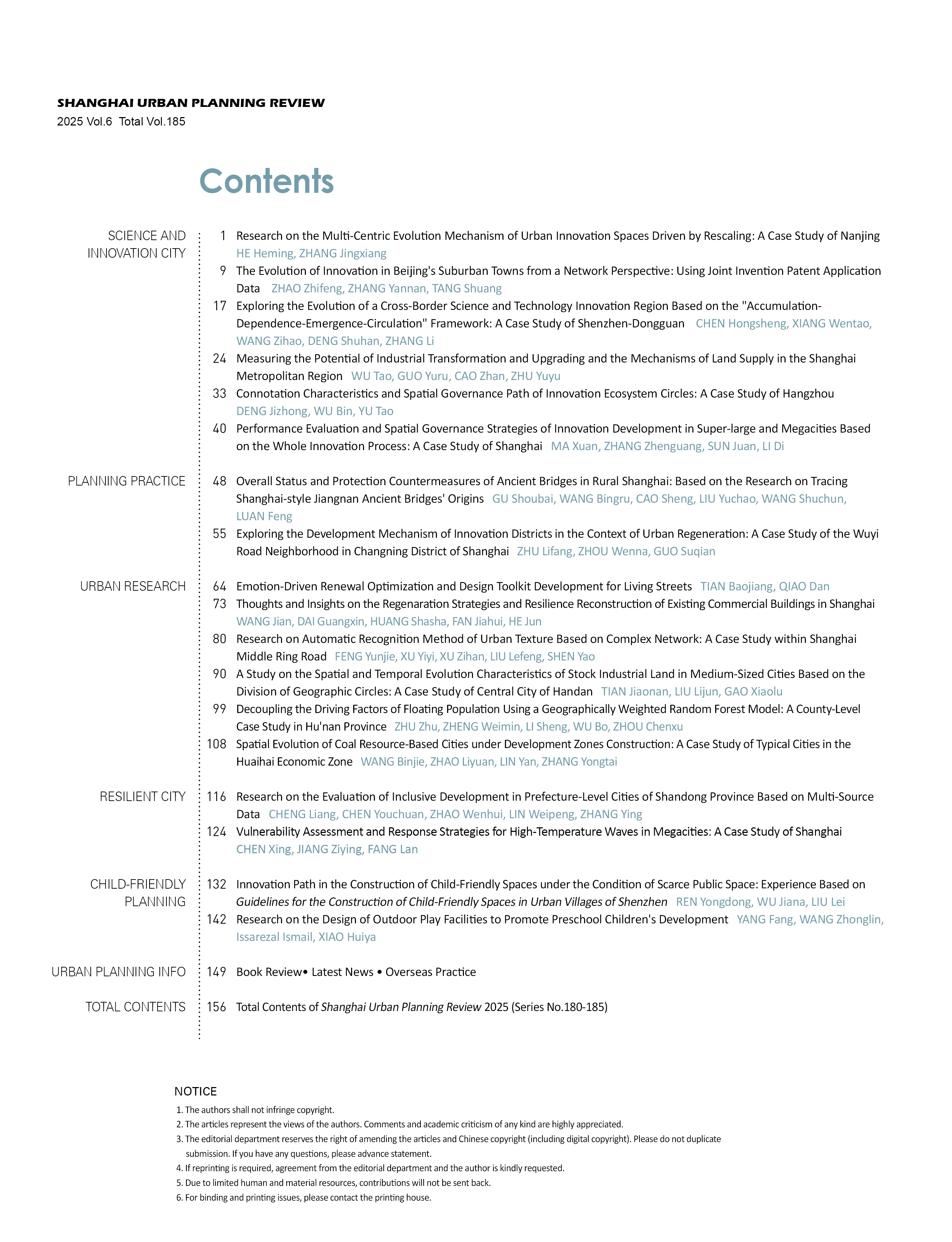
Research on the Multi-Centric Evolution Mechanism of Urban Innovation Spaces Driven by Rescaling: A Case Study of Nanjing
Abstract: The evolution of innovation spaces from a single center to multiple centers is an inevitable trend in the development of science and innovation cities. Understanding this pattern is crucial for the rational allocation of spatial resources. The multi-centric structure of innovation spaces in Chinese cities is not solely a result of market selection but is also influenced by proactive spatial interventions by the government. Drawing on the theory of rescaling, this paper proposes the basic characteristics of multi-scale differentiation in Chinese cities. It argues that methods of rescaling, such as policy-driven new districts and strategic new towns, have altered power relations and locational advantages in specific regions. Innovation enterprises selectively cluster within the framework of multi-scale differentiation, driving the multi-centric evolution of innovation. Using high-tech enterprises in Nanjing as a research sample, the paper analyzes three typical processes of multi-centric innovation evolution driven by national development zones, multifunctional new towns, and national new districts. In the new stage of high-quality development, science and innovation cities should dynamically adjust their rescaling strategies, shifting from stimulating growth to optimizing the innovation ecosystem.
The Evolution of Innovation in Beijing's Suburban Towns from a Network Perspective: Using Joint Invention Patent Application Data
Abstract: Under the traditional paradigm of innovative development, suburban towns have been regarded as the "marginal" areas for innovative functions. The study of network paradigms offers new insights that can inform the innovative development of suburban towns. From the network perspective, this study takes the suburban towns in Beijing as the empirical region, constructs an innovation network based on joint invention patent application data, and classifies the scale types accordingly. Subsequently, we systematically examine the evolutionary characteristics of innovation development in suburban towns and analyzes the driving mechanisms. The results reveal that: (1) The participation of innovation networks in Beijing's suburban towns has been continuously increasing, and in this process, preferential attachment and balanced growth coexist, promoting the overall network towards a multiple corridor configuration. (2) According to the multi-scale characteristics of the innovation network, suburban towns in Beijing can be classified into seven categories, and these types exhibit diverse dynamic evolution trends and spatial aggregation-dispersion patterns. However, the enhancement of cross-border collaboration underscores the exogenous nature of innovation in the periphery. (3) The evolution of innovation types in suburban towns is influenced by the dual tracks of government and market roles, and is also shaped by the two dimensions of the "buzz-and-pipeline" effect, ultimately forming differentiated evolutionary pathways.
Exploring the Evolution of a Cross-Border Science and Technology Innovation Region Based on the "Accumulation-Dependence-Emergence-Circulation" Framework: A Case Study of Shenzhen-Dongguan
Abstract: Scientific and technological (S&T) innovation is a crucial guarantee for megacities to continuously enhance their competitiveness. With the development of regional integration, systematic S&T innovation often transcends the boundaries of a single city, exhibiting an evolutionary trend of cross-boundary sci-tech innovation regions. This paper elaborates on the concept and connotation of cross-boundary sci-tech innovation regions. Taking the highly integrated economic and industrial regions of Shenzhen and Dongguan as examples, it constructs an "Accumulation-Dependence-Emergence-Circulation" theoretical analytical framework to examine the formation process and spatial patterns of the "Shenzhen-Dongguan" cross-boundary innovation region. The study proposes that the formation of the "Shenzhen-Dongguan" cross-boundary region started with the unique economic and industrial accumulation within each individual city, continuously strengthened its S&T foundation along an established development path, and achieved a systemic mutation stimulated by specific internal and external factors. In this process, the formation of the cross-boundary region provided favorable external conditions for the transformation of S&T achievements, enabling S&T innovation to effectively drive the integrated development of the city-region and generate positive feedback to the innovation-source city, thereby further consolidating its leading advantages. The development of S&T innovation must break through spatial constraints, fully leverage the overall advantages of spatial proximity within the region, facilitate the transition from city-based innovation to regional innovation, and maximize the spatial effects generated by S&T innovation.
Measuring the Potential of Industrial Transformation and Upgrading and the Mechanisms of Land Supply in the Shanghai Metropolitan Region
Abstract: Using firm registration data from 2015 to 2022, this study illustrates industrial transformation and upgrading patterns across 112 districts and counties in the Shanghai Metropolitan Region from a dual perspectives of path evolution and capacity evolution, and further constructs a composite measure of potentials of industrial transformation and upgrading by integrating these two dimensions. By incorporating the total volume, pricing, and spatial distribution of land supply across different functions, the study identifies the mechanisms through which land supply influences the potentials of industrial transformation and upgrading. The findings reveal that: (1) industrial transformation exhibits multi-layered and interwoven spatial differentiation, with districts and counties along the Suzhou—Wuxi—Changzhou and Shanghai—Hangzhou—Ningbo corridors demonstrating stronger path-breaking capacity and upgrading momentum; (2) the potential for industrial transformation and upgrading displays a pronounced core–periphery structure; (3) the quantity, price, and spatial layout of land supply exert significant; and (4) the mechanism by which land supply influences industrial transformation and upgrading may vary across counties and districts with different levels of economic development. Through the analytical framework of evolutionary path—evolutionary capacity—transformation potentials—land supply mechanisms, this study elucidates the spatiotemporal characteristics of industrial transformation and upgrading as well as the influencing mechanisms of land supply in the Shanghai Metropolitan Region, offering empirical evidence and policy insights for the synergistic coordination of regional industrial transformation and land supply strategies.
Connotation Characteristics and Spatial Governance Path of Innovation Ecosystem Circles: A Case Study of Hangzhou
Abstract: Innovation spaces have become a key carrier for accelerating the development of new-quality productive forces and an important vehicle for building urban competitiveness and even national competitiveness. Their spatial governance is increasingly becoming a focus of urban spatial attention in the next phase. In recent years, Hangzhou has continuously nurtured emerging functional formats, fostered the embryonic form of innovation ecosystem circles, and demonstrated remarkable representativeness in innovation space practices. This paper analyzes the overall layout and composition of Hangzhou's innovation ecosystem circles, and initially proposes spatial governance paths for such ecosystems. The research findings are as follows: (1) Centered on innovation sources, the innovation ecosystem circles systematically organize the links of "basic research, technological development, and industrial application", gather relevant functions at micro and meso scales, and effectively improve the level of innovation. (2) Innovation ecosystem circles mainly include three types: knowledge-based, technology-based, and industrial-based, which differ in aspects such as the type of innovation sources, the derivation method of innovation links, and the degree of government and market intervention. (3) In terms of functional organization, they cover core innovation functions, related innovation functions, general supporting functions, living services, and ecological functions. (4) The innovation ecosystem circles form a gradient layout relationship in space, requiring differentiated guidance such as land use control, functional organization, transformation of innovation factors, and improvement of the innovation ecology.
Performance Evaluation and Spatial Governance Strategies of Innovation Development in Super-large and Megacities Based on the Whole Innovation Process: A Case Study of Shanghai
Abstract: The latest Central Urban Work Conference emphasizes the establishment of a scientific urban development evaluation system, placing "building innovative cities" at the forefront of the six key national tasks. Focusing on the four stages of the innovation process of a scientific urban development evaluation system, this paper constructs an evaluation framework for innovative cities and conducts an empirical analysis using Shanghai as a case study. The findings reveal that: (1) Shanghai's innovation system exhibits a "strong at both ends but weak in the middle" pattern. While the origination and service stages demonstrate significant advantages, the incubation stage shows high input but low efficiency, and the transformation stage faces challenges due to the weakening of manufacturing advantages. These issues stem mainly from insufficient support for SME incubation and the coexistence of industrial land shortages with vacant commercial buildings. (2) The construction of innovative cities should pay greater attention to spatial support for the incubation stage, dynamic responsiveness to evolving innovation demands, and near-field coordination across all stages of the innovation chain. (3) For Shanghai, enhancing spatial guarantees for incubation and transformation, establishing flexible land-use management mechanisms adaptable to innovation uncertainties, and forming a short-chain collaborative spatial structure are crucial for advancing its innovative city development.