

2026 Vol.1
Megacity's Wetland Spatial Planning
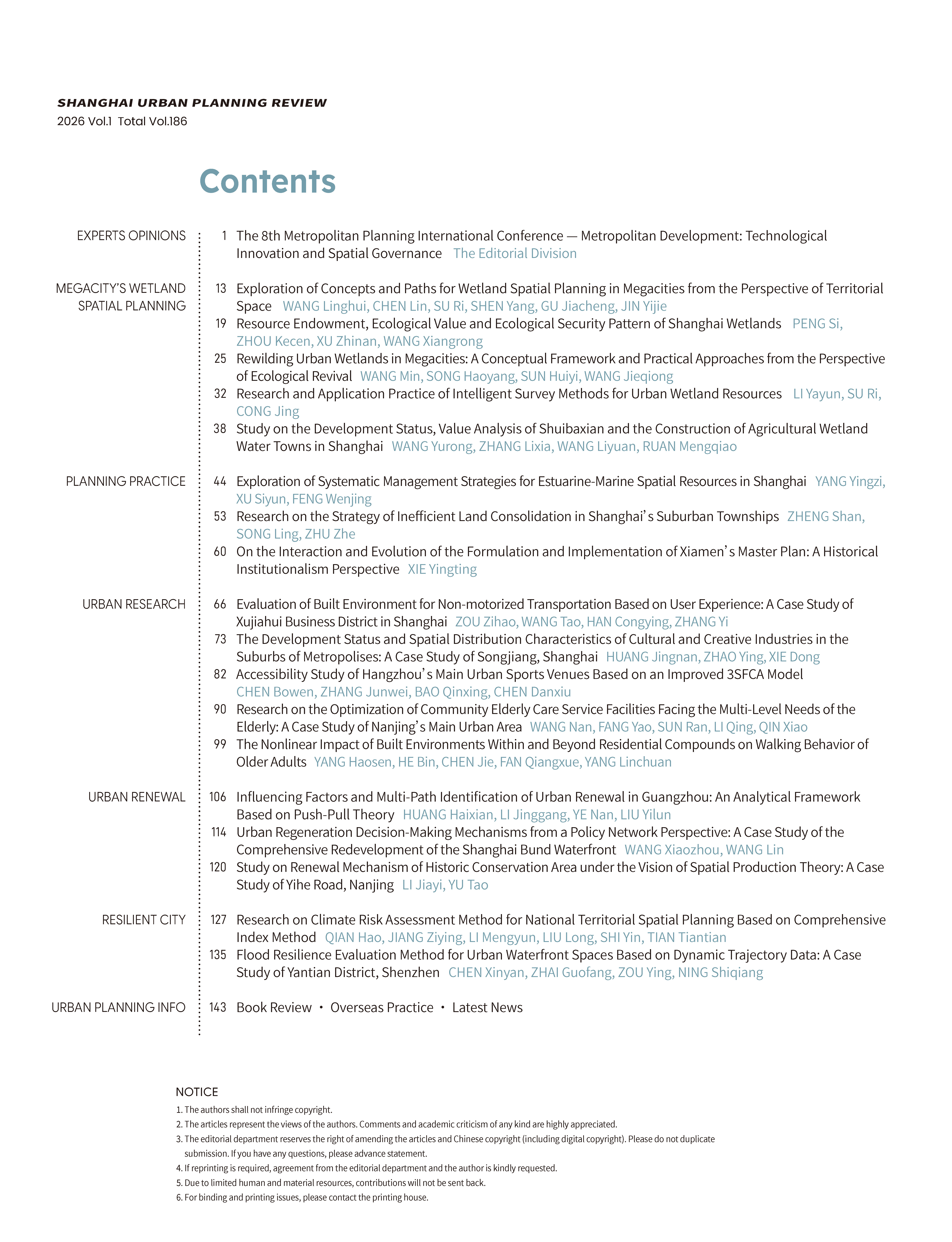
Exploration of Concepts and Paths for Wetland Spatial Planning in Megacities from the Perspective of Territorial Space
Wetland space constitutes a critical component of the comprehensive and multi-element territorial system, serving as a fundamental resource domain for natural resource authorities to fulfill their dual responsibilities of unified natural resource asset management and unified spatial planning and ecological protection. It is also a vital blue-green ecological asset in megacities. However, inconsistencies in wetland definitions, classifications, and standardization frameworks have impeded its full recognition and integration into national territory spatial planning. This paper systematically clarifies the connotation of wetland space, identifies key challenges and issues in its protection and utilization within megacities, and proposes the basic logic and implementation pathways for incorporating wetland space into the national territory spatial planning system, aligned with megacities’ ecological governance requirements. From the core perspective of national territory spatial planning, it synthesizes planning practices of wetland space in international metropolises. Based on the concept of the “life community of mountains, rivers, forests, farmlands, lakes, grassland, and desert”, the paper constructs a multi-plan coordinated wetland spatial planning framework and advances a full-chain implementation pathway of “element identification - pattern construction - hierarchical control - categorical development - implementation action”. This framework aims to strengthen the spatial coupling between wetland protection and urban development, thereby facilitating ecological value transformation and achieving sustainable development goals.
Resource Endowment, Ecological Value and Ecological Security Pattern of Shanghai Wetlands
Shanghai's wetlands hold a strategic position in the ecological security framework of the Yangtze River Delta and represent vital natural capital for urban ecological safety and the national “dual carbon” strategy (carbon peaking and carbon neutrality). Based on data from the Second Shanghai Wetland Resource Survey, remote sensing interpretation, statistical records, and field investigations, this paper analyzes the resource endowments, spatial patterns, and ecological values of Shanghai’s wetlands. The findings reveal that: (1) Shanghai possesses diverse wetland types with extensive coverage primarily consisting of offshore and coastal wetlands. The overall spatial arrangement follows a “ring and radial” pattern which forms a network centered on Chongming Dongtan, Jiuduansha, Dianshan Lake, and Nanhui Dongtan. (2) These wetlands contribute significantly to water conservation, flood regulation, carbon sequestration, and biodiversity maintenance with a total ecosystem service value exceeding 48 billion yuan annually. (3) The research suggests optimizing a functional layout that includes northern estuary conservation, southern coastal protection, western water source conservation, and central urban restoration. This paper also proposes management pathways such as Nature-based Solutions (NbS), ecological compensation mechanisms, and public participation. These results provide scientific evidence for wetland protection and the development of ecological security patterns within the context of the “dual carbon” strategy and the integration of the Yangtze River Delta.
Rewilding Urban Wetlands in Megacities: A Conceptual Framework and Practical Approaches from the Perspective of Ecological Revival
Wetland conservation, as a vital component of ecological civilization construction, is undergoing a paradigm shift from traditional restoration toward ecological revival. Shanghai, a city that has flourished alongside water where urban and wetland systems intertwine, faces the challenge of enhancing the ecological resilience of its wetland spaces and realizing their multiple values. This is crucial for strengthening the blue-green ecological foundation of the megacity and promoting coexistence between humans and water. From the perspective of ecological revival, this study introduces the concept of rewilding and focuses on urban wetlands within Shanghai’s urban development boundary. First, it establishes a conceptual framework for rewilding urban wetland spaces. Then, based on three dimensions—ecological background potential, process recovery potential, and social constraint intensity—an evaluation system for wetland rewilding potential is developed to identify critical wetland areas. Subsequently, a systematic matrix of rewilding technical toolkits is constructed, proposing classified and graded practical pathways for precise implementation. By flexibly integrating a variety of near-natural techniques, the approach aims to restore natural processes, enhance habitat health, and synergize multiple values. The findings open up a new pathway to improve the overall performance of urban wetland spaces and provide a nature-based, systematic solution for strengthening the blue-green spatial resilience of megacities such as Shanghai.
Research and Application Practice of Intelligent Survey Methods for Urban Wetland Resources
Wetland spatial resources constitute an important component of urban natural resources, playing an irreplaceable role in improving urban ecological environment quality and promoting sustainable urban development. However, with the rapid urbanization and under the condition of tight resource constraints, wetland spaces in megacities exhibit characteristics of a more complex and diversified system. Traditional wetland survey methods, constrained by the coarse granularity of survey targets and imperfect methodology systems, struggle to meet the urgent demands for refined and dynamic management of wetland spatial resources in megacities. To further improve management efficiency, this paper investigates key technologies for wetland spatial resource surveys from the perspectives of urban wetland spatial survey classification, multi-source heterogeneous data fusion, construction of standardized databases, and intelligent data collection. It also constructs an intelligent survey framework based on indoor and fieldwork collaboration. Practical work demonstrates that this approach facilitates the identification and analysis of typical wetlands and improves survey efficiency, thereby providing reliable technical support for clarifying the inventory of wetland spatial resources and underpinning scientific planning and intelligent management.
Study on the Development Status, Value Analysis of Shuibaxian and the Construction of Agricultural Wetland Water Towns in Shanghai
Agricultural wetlands constitute the primary type of constructed wetland in Shanghai, serving the dual functions of ensuring food security and enhancing the ecological environment. The “Shuibaxian” (eight traditional aquatic vegetables) are characteristic crops of the Jiangnan region, with their cultivation history and cultural inheritance deeply rooted in Shanghai’s wetland spatial base. This study investigates the current status of the local Shuibaxian industry in Shanghai and evaluates the ecosystem service value and economic value it provides, aiming to support the formulation of scientifically sound cultivation strategies and policy frameworks. The findings indicate that: (1) The primary varieties cultivated in Shanghai are lotus root and wildrice stem, mainly concentrated in districts such as Qingpu, Jinshan, and Chongming; (2) Lotus root cultivation is predominantly characterized by small-scale, scattered farming households, whereas wildrice stem cultivation is largely managed by large-scale growers and cooperatives; (3) Liantang Town in Qingpu District yields the highest ecosystem service value for both lotus root and wildrice stem; (4) Wildrice stem and lotus root, as representative aquatic plants, possess significant economic value, generating substantial returns for growers. Finally, recommendations are proposed for the construction of agricultural wetland water towns in Shanghai by integrating existing district-level foundations and rural planning, encompassing ecological, industrial, and cultural dimensions.